A friend of mine made an offhand observation recently, delivered without much ceremony, which is usually how the truest ones arrive. He wasn't being cynical. He was describing the weather: how much of American life runs on the machinery of in-groups and out-groups. It stayed with me, less because it was novel than because it was precise.
I come to this as an outsider with partial standing. Where I'm from, group belonging matters just as much, maybe more nakedly. But it's enforced socially, by gossip and shame, rather than institutionally, by admissions committees and HR departments and homeowners' associations with the legal standing to enforce a covenant. The American version wears a uniform, and that distinction is what wouldn't leave me alone.
America's founding conceit is that it has no castes: no hereditary lords, no fixed rank at birth, a person rises or falls on what they earn. This is sincerely held, and compared to the alternatives on offer through most of human history, bribery, blood, the accident of a good surname, the promise that position should track merit is a genuine advance.
The catch is not small, though. Michael Young coined "meritocracy" in 1958 as a warning, and Michael Sandel worked out its implications more recently: if status is earned rather than inherited, then not having status stops being an accident and becomes evidence. The aristocrat's poor cousin could blame his blood. The meritocracy's excluded have no one left to blame but themselves, which is either the most honest thing a society has said about failure, or the cruelest, and it doesn't require an inquisitor to enforce. It just needs a ranking.
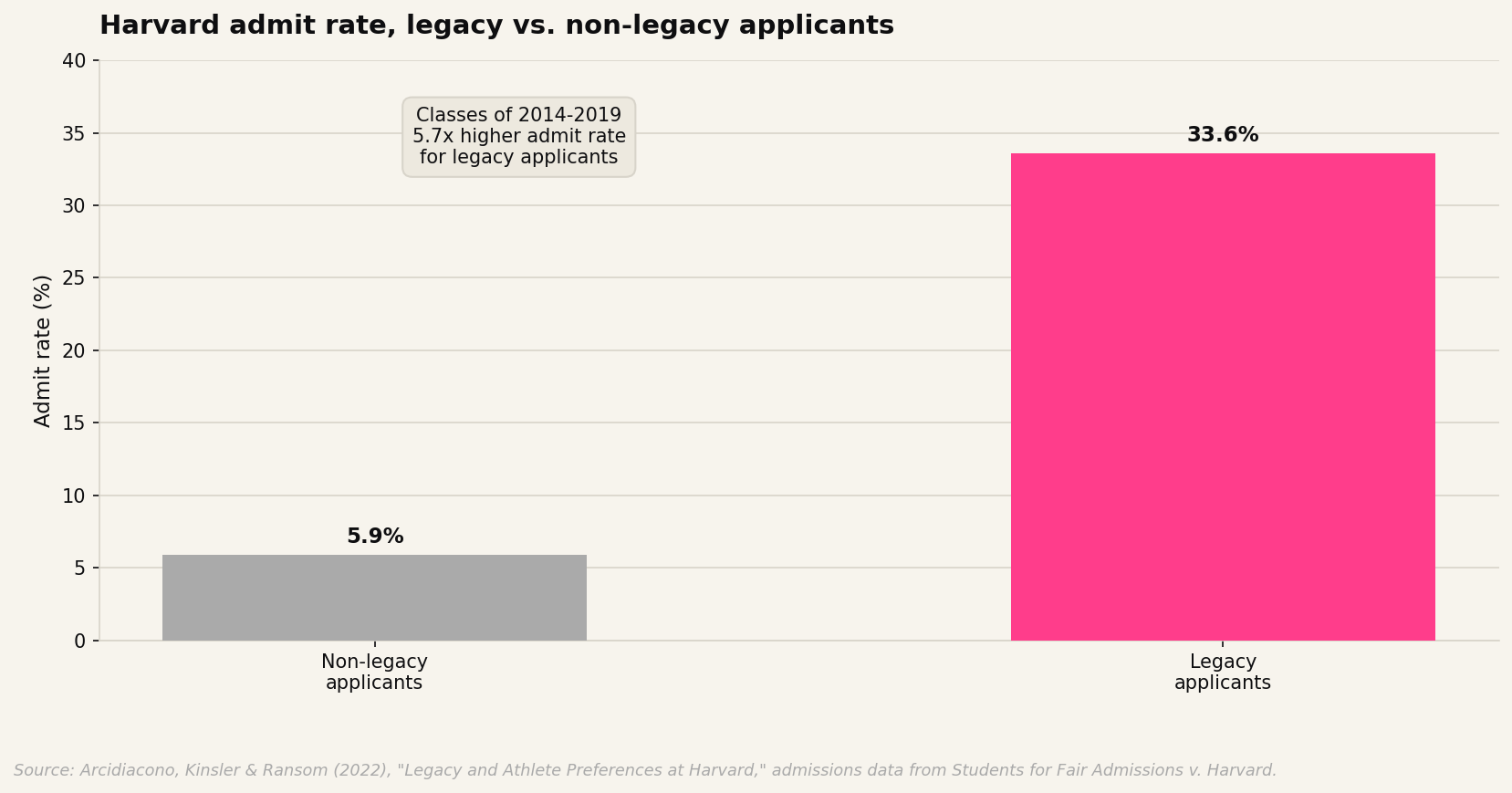
The university is the clearest case. At Harvard, legacy applicants, the sons and daughters of alumni, were admitted at 33.6% in the classes of 2014 through 2019, against 5.9% for everyone else, a 5.7-times gap, in data made public through the Students for Fair Admissions v. Harvard litigation and later analyzed by Arcidiacono, Kinsler, and Ransom. Dean of Admissions William Fitzsimmons has said legacy applicants are simply stronger candidates on average, and raw rates alone can't rule that out. Michael Hurwitz's study of thirty selective colleges gets closer to isolating the preference itself: holding academic and other credentials fixed, an applicant whose parent attended the school saw admission odds jump from a baseline of 15% to roughly 60%. This is hereditary preference, laundered through an institution that says it selects for merit, and the laundering is the point. Of the hundred most selective American universities, only 27 have ever voluntarily given it up.
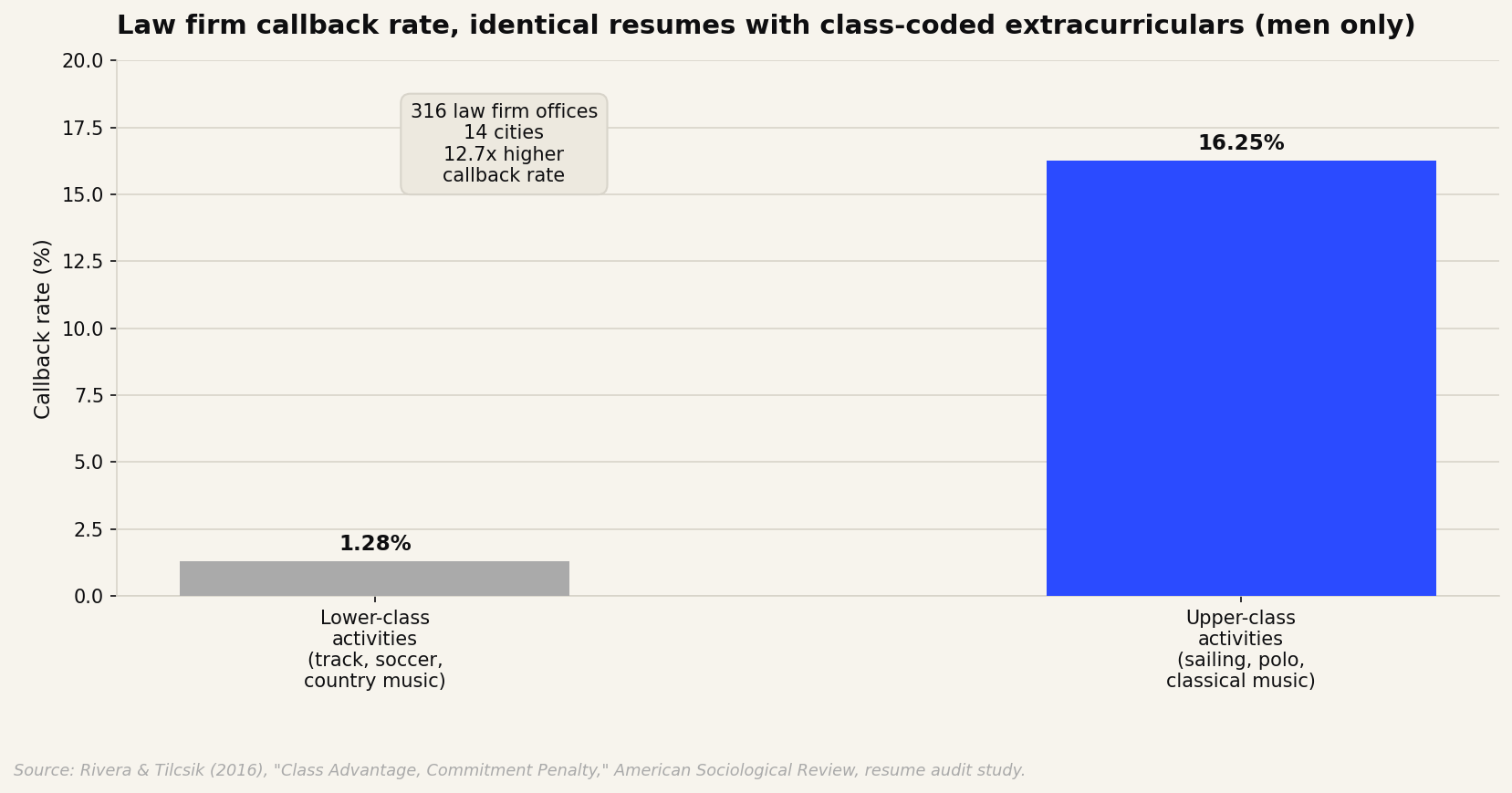
The office runs a quieter version of the same sort. Sociologist Lauren Rivera spent months inside elite law, consulting, and banking firms, and when she asked hiring managers what "culture fit" actually meant, they told her: bonding over rowing crew, getting scuba certified, sipping single-malt Scotch, dining somewhere Michelin-starred. A stated passion for teamwork didn't count. In a follow-up resume audit with András Tilcsik, fictitious applicants sent to 316 law firm offices across 14 cities got callbacks at 16.25% when their resumes listed sailing, polo, and classical music, and at 1.28% when they listed track, soccer, and country music, a 12.7-times gap between two men with identical grades and identical credentials. The only thing separating them was which hobbies signaled the right kind of upbringing.
The same sorting logic runs downward into the high school hallway, long before anyone involved is old enough to vote, and outward into the HOA covenant and the school catchment line, mechanisms with actual legal teeth doing at the level of real estate what admissions committees do at the level of the transcript. At every scale, belonging gets framed as earned, so exclusion can be framed as deserved.
None of this requires malice. It requires an ideology sincere enough to believe its own sorting is fair, applied by people who mostly aren't lying when they say they hired the person who fit.
What it produces, at the bottom of the sort, doesn't have a formal name, because a country built on the claim that it has no castes can't officially admit to a caste of the excluded. The rating scale, the resume audit, and the covenant do the same job a hereditary caste system did, deciding who's in before anyone gets a fair look at what they can actually do, they just do it with better paperwork.