In 2023, for the first time in Statistics Canada's Canadian Income Survey, men 65 and over had higher average total income than men 25-34. In 2023, men 65+ averaged $62,800 against $62,600 for men 25-34, a narrow crossing. In 2024, the gap widened: $64,100 for men 65 and over against $61,600 for men 25-34, all in 2024 constant dollars.
Total income here means everything: wages and salaries, self-employment income, investment income, CPP and QPP pension payments, Old Age Security, and any other government transfers. For men in their late 20s and early 30s, it is mostly wages. For men 65 and over, it is a mix of retirement income and, for a growing subset, continued employment income.
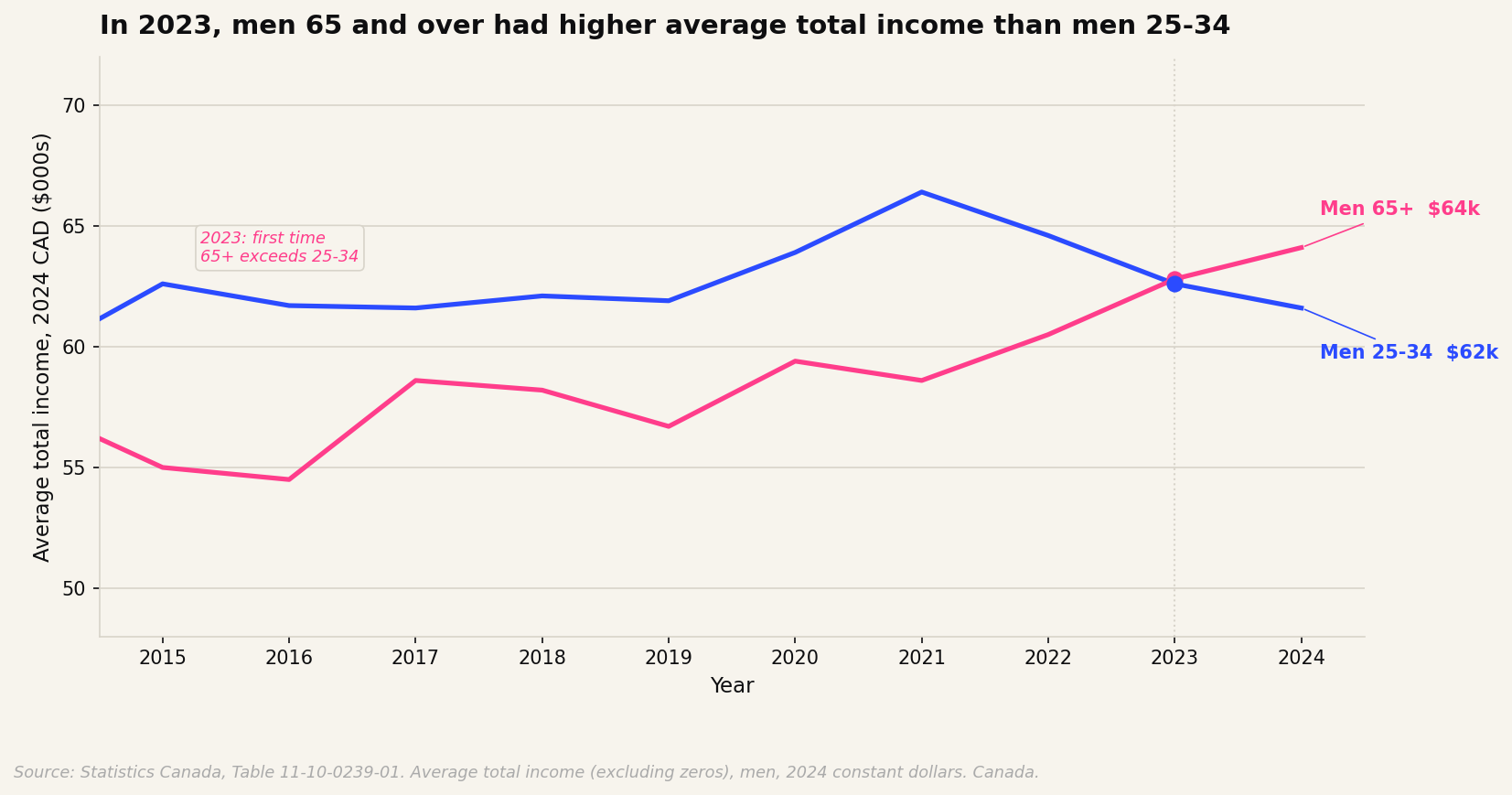
The crossover in 2023 is a first in the available data, which goes back to 2015. Whether this is literally the first time in Canadian history is harder to establish with earlier surveys using different methodologies, but the trend lines suggest the gap had been closing for years before the data window opens.
The crossover shows up in averages, not medians. The median tells a different story: in 2024, the median total income for men 25-34 was $52,700 against $46,400 for men 65 and over. The typical man in his late 20s or early 30s still out-earns the typical man over 65.
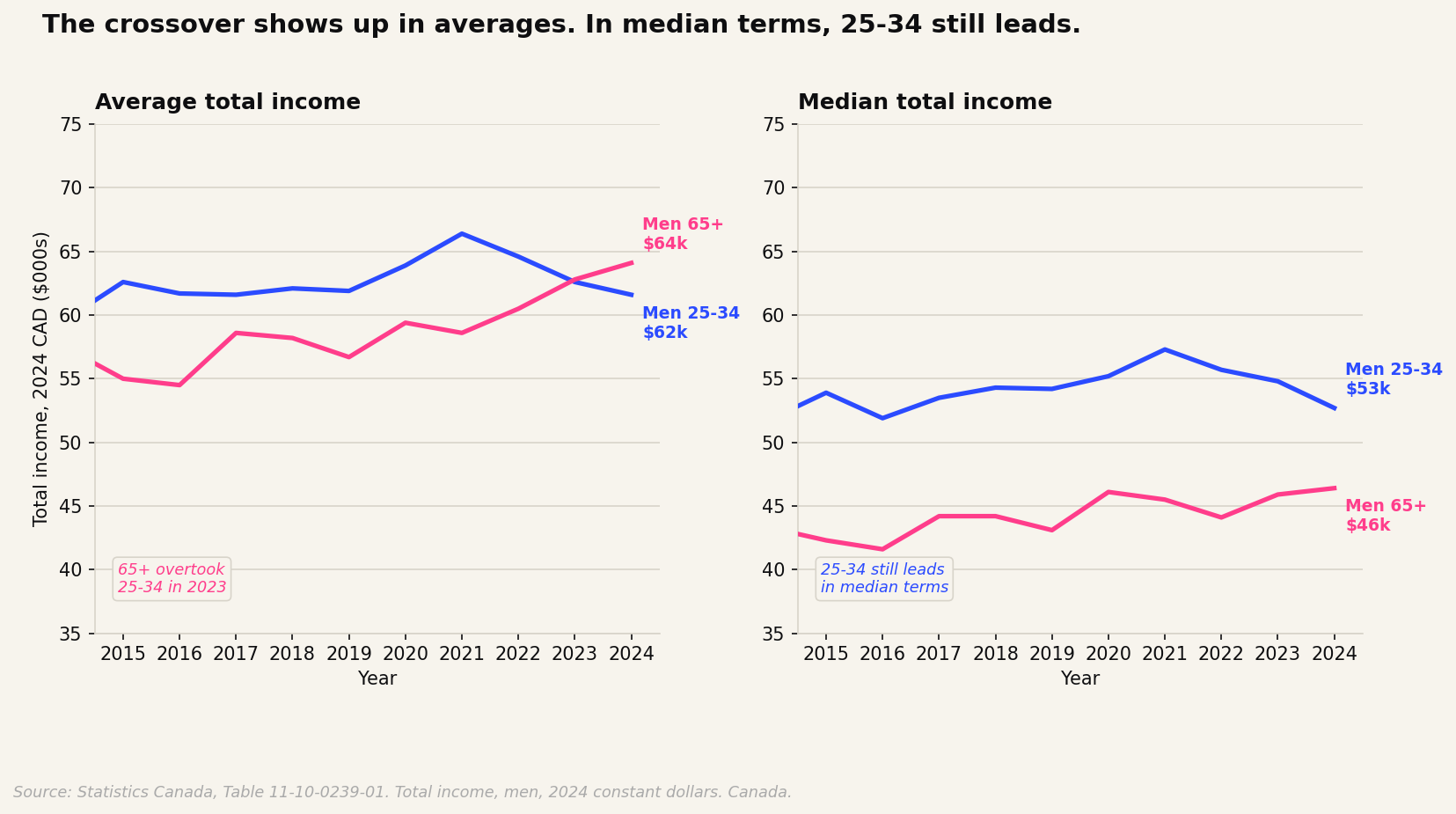
The divergence between average and median signals a distribution effect. The men 65 and over who are drawing high investment returns, substantial pensions, and continued professional income pull the average up considerably. The median reflects the more common situation: a 65-year-old living primarily on CPP, OAS, and modest savings, earning less than a working 25-34 year old.
The broader picture across all age groups shows men 25-34 sitting near the bottom of the earnings distribution and losing ground over the period.
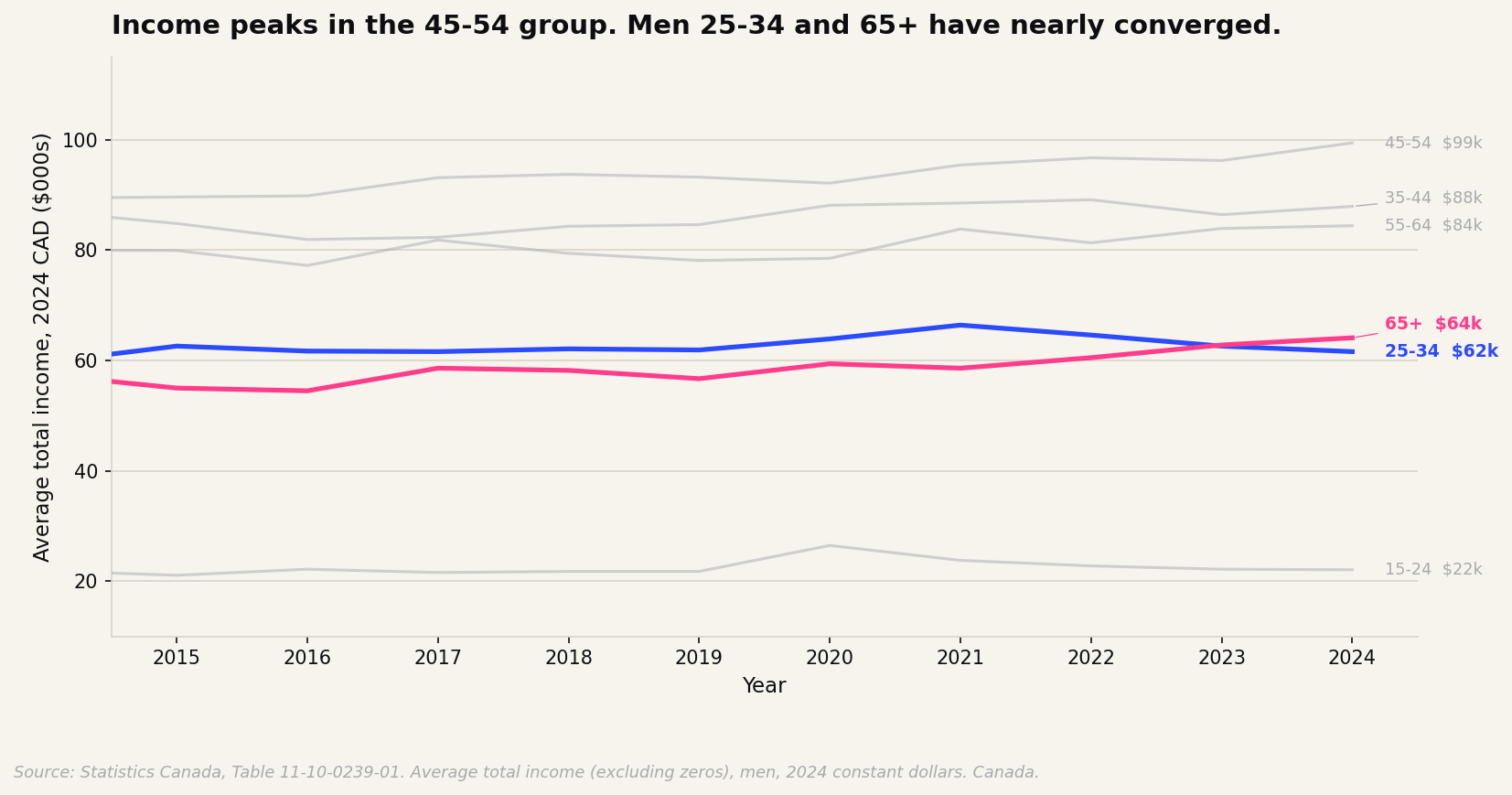
Men 45-54 remain the highest-earning group at $99,400 average total income in 2024. Men 25-34 averaged $61,600, down from $63,900 in 2021 in real terms. Men 65 and over, meanwhile, rose from $59,400 in 2020 to $64,100 in 2024.
Two things are happening simultaneously. Older Canadians are drawing higher retirement income as CPP benefits have grown and as a larger cohort with longer contribution histories reaches retirement age. And men in their late 20s and early 30s are entering a labour market where real wage growth has been modest and where a larger share of income goes to housing before it shows up in any income survey.
The main caveat is the income definition. Total income for men 65 and over is not comparable to total income for men 25-34 in any meaningful labour market sense. CPP and OAS are deferred compensation for decades of prior contributions, not current earnings in the conventional sense. Comparing them to the wages of someone at the start of their career is legitimate for understanding living standards and income distribution, but it conflates categories that measure different things.
The second caveat is that the crossover is sensitive to the specific year. The data period is short, the gap in 2023 was $200, and one or two years of stronger wage growth for younger men could reverse it. What is more durable is the direction of travel: the retirement income of older Canadians is rising, and the real wages of younger men have been broadly flat.
Data: Statistics Canada, Table 11-10-0239-01. Total income of individuals by age group, gender and income source. Average and median total income, men, 2024 constant dollars, Canada. Data available 2015-2024.